Yesterday, I was lucky enough to listen to a lecture given by the artist and writer, Jade Montserrat. An artist of whom I’d never heard of before that afternoon, and though I’m usually not a fan of performance art, the aesthetics of her pieces caught my attention and I will most likely ensure I keep track of her next few exhibitions.
Throughout the lecture, a (sped up) visual documentation of one of her ‘No Need For Clothing’ performance pieces was playing in the background. She was nude in a large open, white room, using charcoal to write out short pieces across the entirety of the broad canvas, after which a man came along, fully clothed and washed the walls clean. When asked about the reason for being naked in many of her performance pieces; she believed that bodies were tools for action and very vulnerable, requiring no clothing. She also replied that it was a basis for conversation and reflection. And she was right.
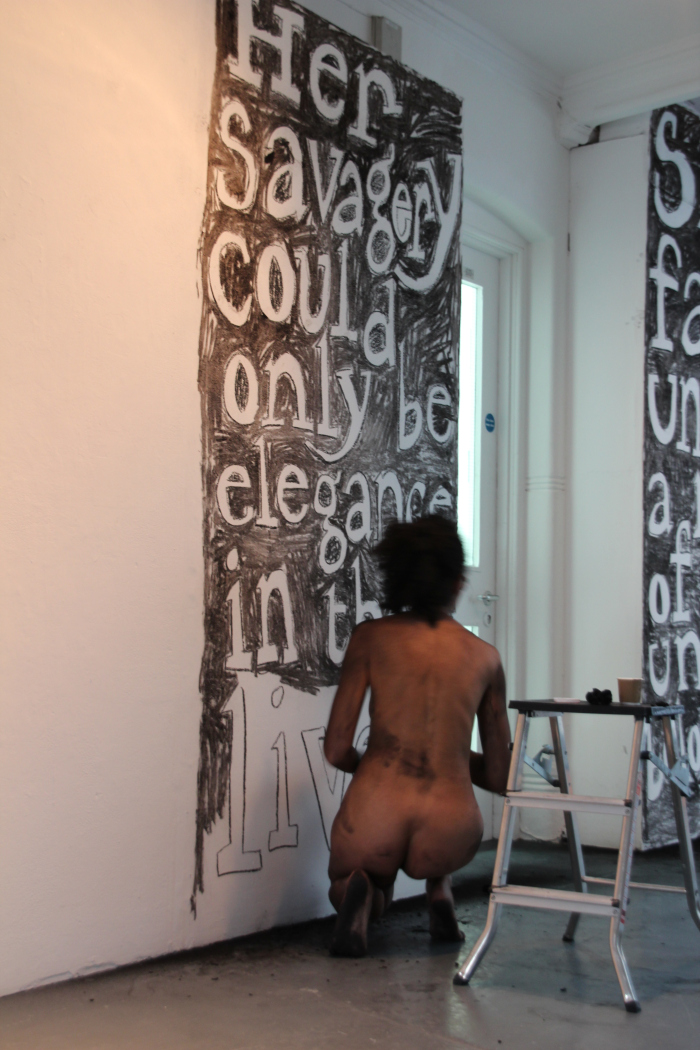
The main focus of her work is “colonial administrative processes” and decolonisation through structural racism. Having never experienced such things and discrimination in my own life, I’d say I learnt a lot from what she spoke about; specifically how black British history is different to black american history. In America it is a dehumanising value and segregation is the answer whereas in Britian the answer is ignorance. A simple distorted sense of reality. She similarly acknowledged the currently world-renown and very widely despised ‘Make America Great Again’ slogan, showing how it implies ‘Great’ actually means ‘White’
“We have all been programmed to respond to the human differences between us with fear and loathing and to handle that difference in one of three ways: ignore it, and if that is not possible, copy it if we think it is dominant, or destroy it if we think it is subordinate.”
She portrays the ignorance boldly, calling out on how many attempt to handle difference. It is a mature direction onto her memory work, where she acknowledges how past artists have been revered or scorned, particularly her favourite, Josephine Baker. It is clear that Baker’s practise (such as the ‘Banana Dance’) has influenced the flow of Montserrat’s own work, as she plans to do a 24hour performance piece next week, streamed to where Baker performed in her life. It will be a way to reimagine the black body through, bondage, repair, consumption and dance marathons.
Overall, Montserrat’s lecture was full on and at times hard to swallow as her bold individuality and strong feminist ways spoke a lot of truth, widely unacknowledged recently. She is a lady of radical expression pursuing arguments of sexuality, race, desire and class, challenging social and cultural invisibility through performance and written word. (I will definitely be reading further into the piece by Montserrat and American curator Daniella Rose King; and I would suggest it to anyone.)

 HXLLISON ART HISTORY