This morning I managed to squeeze in seeing Tom Railton’s presentation, where he described his work based on collections and archival stock. His maquette’s and small sculptures reflect the marble sculptures from the Rococo period, and remind me of those found locally in the Walker Art Gallery (as well as other galleries). He explains how his subject matter and concept is developed later on and is there; not a preemptive idea, almost explained itself through the way he presents his work as a collective.
By not having this clear focus of an outcome, his work can become quite comedic. The outcomes can be anything from an accurate portrait, to a basic lump or unusual shape. He admitted he was happy for people to find the amusing angle of it, as it meant people were talking about the pieces after the exhibition. Some of the names of his work are in Chinese, (赌石) not only can he not understand them, but we can’t either (they could literally be called anything). Others, however, have English names, such as ‘Simply Black’ 2016, which exploited a modern day society. He used the release of the iPhone 7 (in black) to actively pursue his interest in obsidian, polished glass etc to create a piece that resembled a crushed/distorted phone screen.
“Phone screens act in the same way as early mirrors (looking glasses) when turned off, but can be used for checking make-up, spots etc when using the selfie camera function – also the internet provides access to the things people in the past may have tried to foresee in pools or obsidian.” (Railton, T. 2016)
Through this perception of the digital world, he had us all questioning our use of phones and in particular, the broken screens. I broke my screen a ew weeks ago, but nearly immediately got used to the distortion that it causes; Railton made me think of how aesthetics have taken over practicality and developments. He used this idea to research the early humans’ use of sharpening tools and perfecting them; and so tied together the most developed resources of each time period.
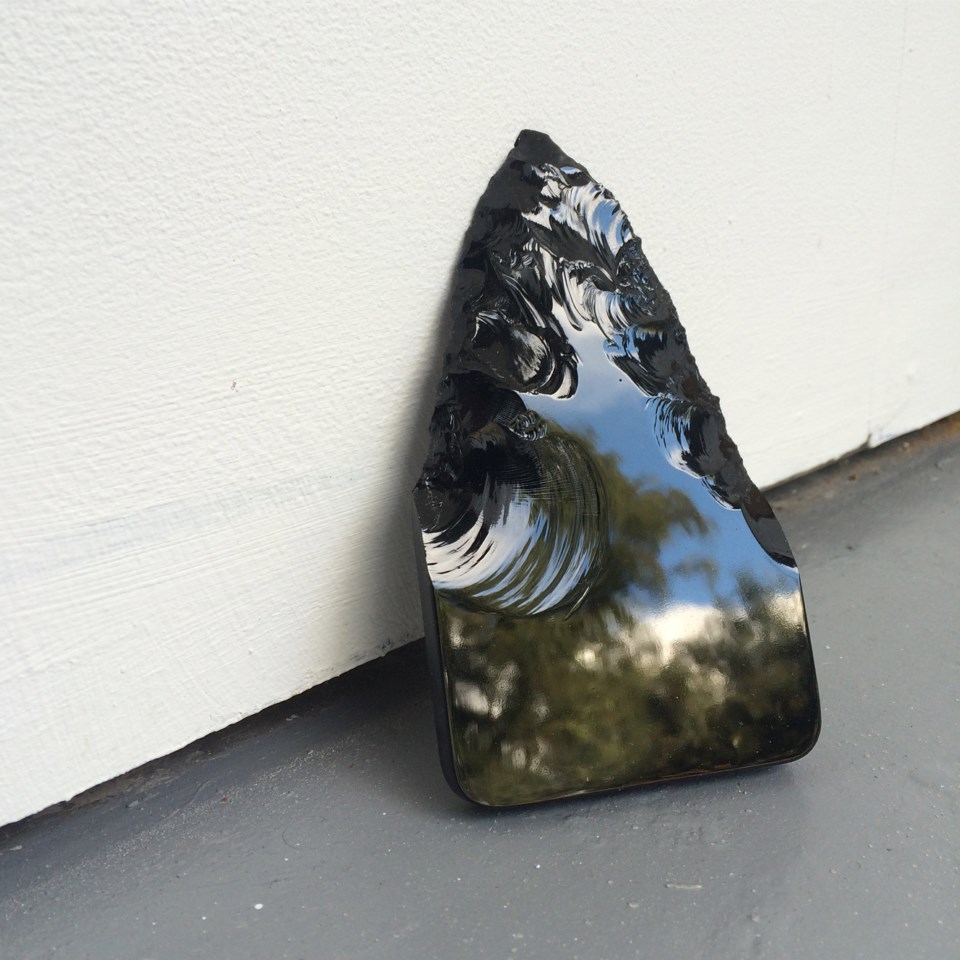
Railton, R. 2016. Simply Black. [Obsidian carved] London, England.

 HXLLISON ART HISTORY