Today we visited the Castle Foundry in Liverpool’s flourishing Baltic Triangle area, in recent years it has become a busy area of art and creatives alongside popular coffee shops and businesses.The Foundry is a huge studio space dedicated to bronze casting, a process that today I discovered, involves many layers of work to achieve that final product. We were given a short talk about these processes but I was much more blown away by seeing it all in action and following it in a chronological way through the vast studio space.
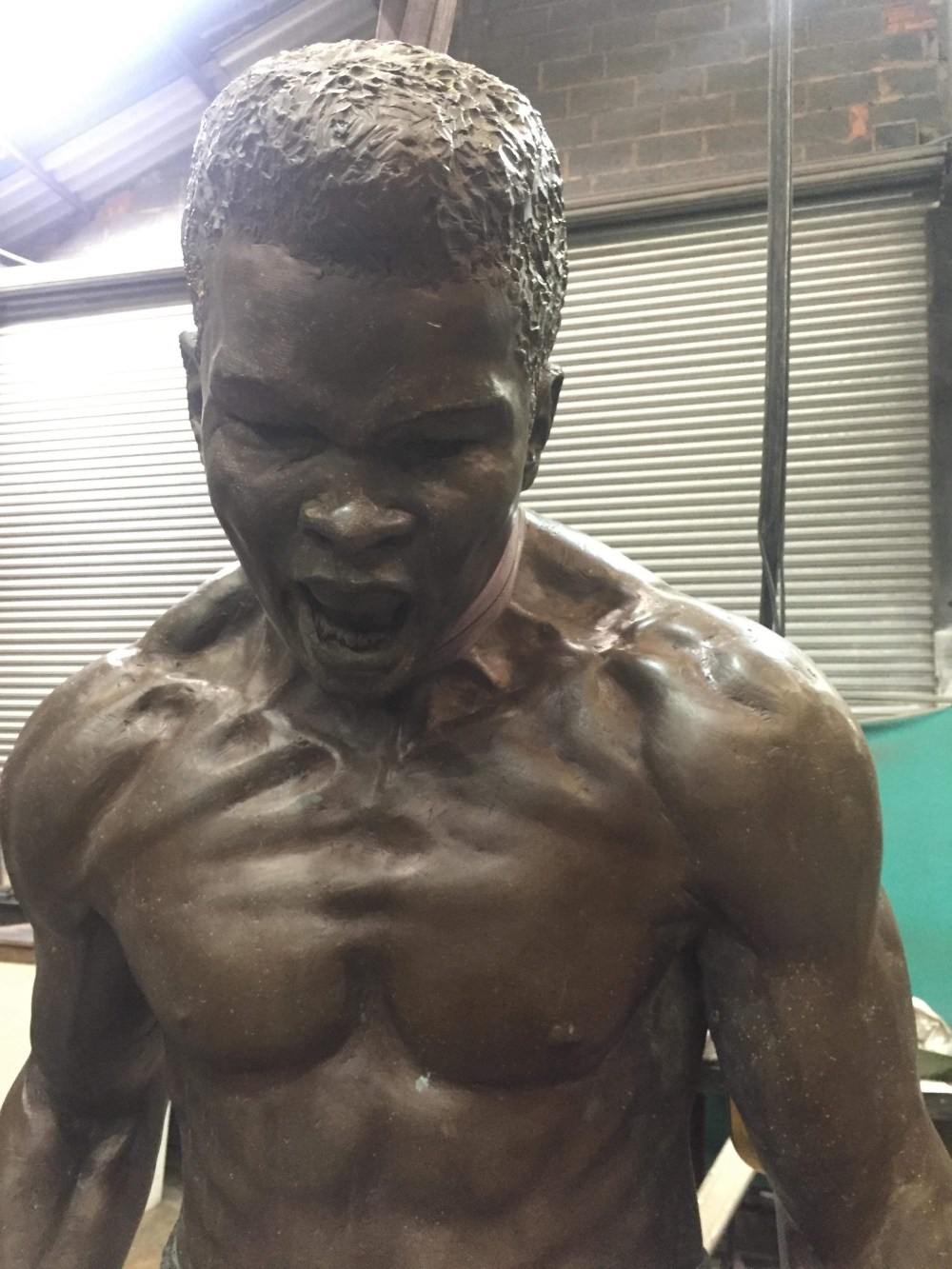
Prior to a tour of the workshop, we watched a video of the creation of the classic Muhammad Ali sculpture they produced in partnership with the Baltic Triangle for the plinth space on Jamaica Street. The plinth has a turnaround of sculptures produced by the Foundry, and the Mohammed Ali one is still one of the most famous. The process was really interesting, watching the waxwork be created, the China cover enclosing it and the bronze being moulded; particularly when they had to reattached certain parts that must be removed for casting, like the arms and legs. I thought those attached joints would create weak points within the sculpture, but was surprised to hear it is just as strong. We were then lucky enough on our tour to see the completed sculpture which they had pulled out of storage for us especially.
Other sculptures on view included a few others of the old plinth statues which I recognised from having commuted through that area for a few years now, there was also a few castings occurring of Sophie Ryder’s extremely large hare sculptures; she is one of the Foundary’s reoccurring customers. (I actually walked past the Foundry of my way to Tate the other day and saw her completed harethrough the shutter doors and immediately recognised it, but at the time had no idea that is where the Foundry is, and that they work with her).
The team are currently helping her on a new project happening this summer all around London, were her hares will be spread throughout the city. Whilst most of them are readily available to be moved or have the casts to recreate them, we were lucky to see them taking a cast of one that has not been repeated. The casting had been destroyed and so to keep a log of the movement and whereabouts of each sculpture they are creating another for her to use so one is not lost.

Here they are waiting for the layers of rubber silicone casting to set in order to apply a finer glass case (to keep the shape), which will then be cast in bronze and fitted back together for the final product.
After leaving the Foundry we wandered down to the current plinth sculpture, just a few minutes away, to see it is a large Roman soldier. However this time it is not cast bronze, but slices and pieces of bronze welded and screwed to together. This is very unlike any of their other sculptures which usually hide the method of creation; this one outrightly shows the seams and connections. The chain mail on the soldier are mind blowing too, each one individually created and hooped together by hand, to make it unbelievably realistic. I hope to be able to revisit the Foundry in the future to see what other projects they have going on, and can’t wait to see the next plinth feature now I know who creates it.

 HXLLISON ART HISTORY